The statistics are unforgiving: 22% of ventures fail in year one; 50% effectively cease operations by year five. While capital constraints (cash flow) are often cited as the primary cause, they are usually a symptom of deeper structural flaws.
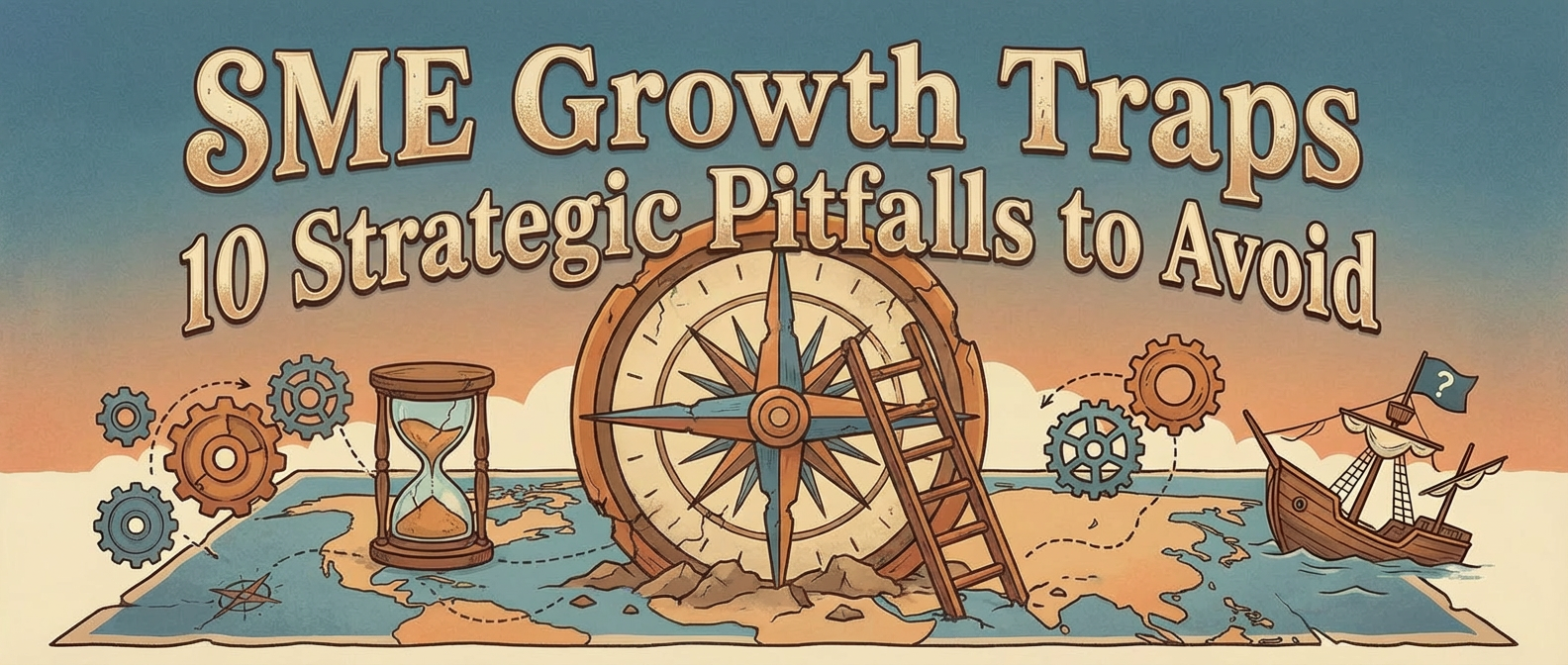
For the modern enterprise leader, avoiding failure is not about "working harder" it is about Operational Governance. Based on market analysis, here are the 10 critical friction points that prevent small businesses from scaling into resilient enterprises.
1
The "Passion Trap" (Governance vs. Emotion)
The Failure: Treating the business as a personal project rather than a separate entity.
The Pivot: "It's not personal, it's business" is not just a cliché it is a governance mandate. Successful scaling requires decoupling leadership emotion from data- driven decision- making. You must run on metrics, processes, and financial rules not just founder intuition.
2
Misalignment of Product-Market Fit
The Failure: Building a solution looking for a problem.
The Insight: You may love your service, but the market pays for pain relief. If you cannot articulate the specific problem you solve and the financial value of solving it, you do not have a business you have a hobby.
3
The "Vacuum Strategy" (Lack of Competitive Intelligence)
The Failure: Launching without a clear differentiation strategy.
The Pivot: You do not operate in a silo. To win, you must utilize frameworks like the Business Model Canvas to map your competitive landscape. Consider Geico. In a commoditized, boring market (insurance), they didn't compete on "trust" like banks they competed on "personality" and "speed." They differentiated by breaking the industry archetype.
4
The "Product-First" Fallacy
The Failure: Believing a superior product guarantees market share.
The Reality: A great product is only the baseline. Success requires the "Three Pillars of Presence":Visibility: Brand awareness.
Authority: Reasons to believe (Case studies).
Credibility: Social proof (Testimonials).
5
Company vs. Brand (The Identity Gap)
The Failure: Registering an LLC and calling it a brand.
The Pivot: A company is a legal entity a Brand is a codified set of promises and experiences. If you don't intentionally architect your brand identity your voice, your visual language, your values the market will define it for you (usually incorrectly).
6
Innovation Stagnation
The Failure: Ignoring the "S- Curve" of technology adoption.
The Lesson: History is a graveyard of giants who refused to pivot. Blockbuster ignored streaming Nokia ignored the touchscreen Kodak ignored digital.
Eiden Insight: Culture does not stand still. If your business model isn't adapting to macro- trends (like the shift to AI or Electric Vehicles), you are already obsolete.
7
Toxic Internal Culture
The Failure: Neglecting the "Inside Game."
The Pivot: Your external brand is a reflection of your internal culture. Look at Zappos they sold a commodity (shoes) but exited for $1.2B because they built a culture of service that was impossible to replicate. Business is a team sport; you must train, delegate, and reward performance.
8
The CX Gap (The Underrated Variable)
The Failure: Underestimating the geometric growth of Customer Experience (CX).
The Metric: In the age of digital amplification, one bad interaction is a PR crisis; one great interaction is a viral marketing asset.
The Edge: In a world of chatbots and offshoring, Human Touch is the new luxury differentiator.
9
Absence of a Go-to-Market (GTM) Plan
The Failure: "Build it and they will come."
The Pivot: You need a mapped logistics chain for attention. How do you capture it? How do you transport that attention to a point of sale? Whether it's a digital portal or a physical retail outlet, the path to purchase must be engineered, not hoped for.
10
The "Founder's Ceiling" (Ego vs. Expertise)
The Failure: The belief that the founder must be the expert in everything.
The Pivot: Smart scaling means knowing what you don't know. You don't need to hire full- time executives immediately; you can retain fractional consultants for high- leverage roles (Finance, Strategy, Marketing). This gives you Fortune 500 expertise at a fraction of the overhead.